AI & strategy Arjan·Managing Director
Why your AI chatbot frustrates customers more often than it helps
Arjan·Managing Director Google Premier Partner
 Meta Business Partner
CMOs put 15.3% of their marketing budget into AI, yet only 30% of organisations are ready to scale it. What the gap means for your marketing team.

On the agenda of marketing directors, AI moved from a side topic to the main course over the past year. In the CMO Barometer by Serviceplan and Adformatie, a survey of 805 European marketing directors, a sizeable share of them Dutch, only 3 percent named AI and marketing automation as a hot topic a year ago. Now it is 47 percent. At the same time, the Gartner CMO Spend Survey 2026 among 401 marketing leaders shows that CMOs spend an average of 15.3 percent of their marketing budget on AI, while only 30 percent of organisations say they are genuinely ready to scale AI. Budgets are growing faster than the organisation around them can keep up. That gap is the problem most articles about new AI tools skip past, and it is exactly where marketing teams need to invest their time now.
The figures from the CMO Barometer leave little doubt about where the attention lies. 83 percent of Dutch CMOs use ChatGPT daily, mainly for generating ideas, inspiration and concepting. AI knowledge now sits in the top three competencies teams need, alongside creativity and strategic insight. Strikingly, this is happening while these same CMOs are more cautious about the economy: only 21 percent expect an improvement in 2026, compared with almost half a year earlier. Even so, more than 40 percent expect a higher marketing budget, while 21 percent anticipate a cut, nearly double the previous figure.
What we often see in marketing teams is that this combination, more enthusiasm about AI alongside more budget uncertainty, leads to quick experiments. A loose ChatGPT subscription here, an AI plugin in the content workflow there. That explains the jump to 47 percent as a hot topic. It does not automatically explain whether those experiments pay off.
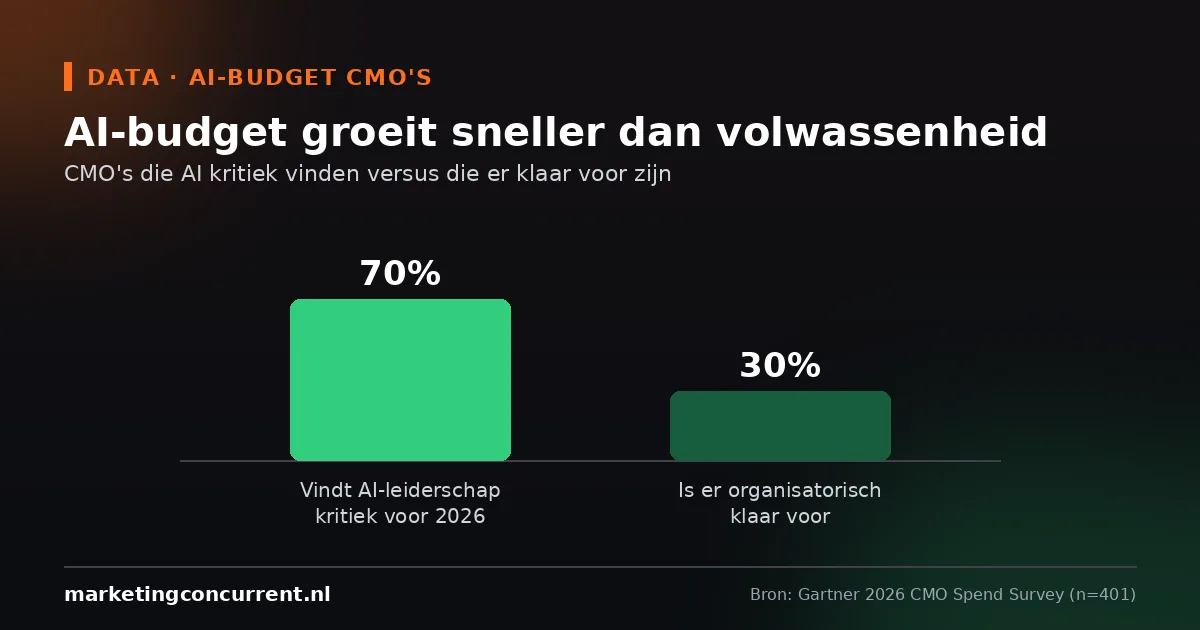
Gartner's figures expose that gap. 70 percent of CMOs call becoming an AI leader a critical goal for 2026. Only 30 percent have the maturity and capabilities to make it happen. Organisations that do count as AI-mature allocate an average of 21.3 percent of their marketing budget to AI, against 15.3 percent on average, and also have a larger total budget: 8.9 percent of company revenue versus 7.8 percent. Maturity and budget reinforce each other, but the majority still sits on the wrong side of that line. On top of that, 56 percent of CMOs say they lack sufficient budget for their 2026 strategy, and 54 percent struggle with a general shortage of resources.
The risk is that CMOs invest in AI tools faster than they build the data foundations, processes, governance and talent, warns Gartner analyst Ewan McIntyre.
Those data foundations, governance and talent are not abstract concepts. They come down to questions such as: is customer data clean and centralised enough for an AI model to do anything useful with it, is someone accountable when an AI-generated campaign misses the mark, and does the team have the skills to assess AI output instead of publishing it unquestioningly. Without that base, 15 percent of budget in AI is mostly 15 percent of budget in experiments that do not scale.
The temptation is to close the gap with yet another tool: a new AI platform for content production, a smarter bidding strategy, an extra chatbot. Gartner puts it more sharply. Success depends on bold, data-driven choices about what teams stop doing, not only about what they add. That is an uncomfortable message for a sector used to growing by expanding.
In concrete terms this means three things for most marketing teams. First, an audit of the data foundations before another AI tool is added: do you know which data you have, where it comes from and whether it is reliable enough to steer by. Second, a designated owner for AI governance within the marketing team, someone who not only approves tools but also judges which AI output may go out without a human check. Third, an explicit upskilling budget, separate from the tool budget, because you do not get AI knowledge into the top three team competencies with a single subscription.
At channel level, the difference shows up most in content production and performance advertising, the two areas where AI tools are adopted fastest according to the CMO Barometer. That is where the temptation to steer purely on adoption is greatest, and exactly where the KPIs need to correct course. Do not measure how much budget goes to AI or how many employees have opened a tool. Measure the time-to-value of an AI pilot before you scale it, the percentage of AI use cases with demonstrable ROI after three months, and the share of the team that reaches a baseline score on AI literacy. Anyone who only reports budget growth to the board is reporting half the story.
A common pitfall is that the tool budget gets all the attention while the training budget is the first to go in the first round of cuts. What works better in practice: with every new AI purchase, reserve a fixed share of the budget up front for onboarding and a short training session for the team that will work with it, rather than bolting it on afterwards once usage disappoints. That is not a heavy governance exercise, more a standing rule that stops a tool ending up unused in a drawer after three months.
It comes down to four building blocks: clean and accessible data, a governance structure with someone accountable for AI output, enough skills in the team to assess that output, and an operating model in which AI projects get the same discipline as other investments. Only when these four are in place does scaling make sense.
Not necessarily less, but more deliberately. Gartner advises treating AI as a means to work more efficiently, not as an extra luxury on top of the existing budget. Shift part of the tool budget to data clean-up, governance and training, so that the tools you already have actually pay off before you expand.
Look at the time-to-value of pilots, the percentage of AI use cases with measurable ROI after a fixed number of months, and the level of AI literacy within the team. Adoption figures, such as the number of employees with access to a tool, say little about maturity and do not belong as a headline KPI on the board's dashboard.
Founder and managing director of MarketingConcurrent, building AI tooling for marketing and e-commerce with AIbove and DropMetrics. Questions about this article? Book a strategy call or meet the whole team.
Arjan·Managing Director