Google Premier Partner
 Meta Business Partner
Many business owners see an AI chatbot as a quick way to improve customer service while cutting staff costs at the same time. New Dutch consumer research puts serious question marks over that idea, and the pattern will look familiar to anyone running customer service in the UK, Germany or elsewhere in Europe. The Nationale Voice Monitor 2026 found that only 12 percent of questions put to chatbots are answered properly, and that half of respondents get frustrated by a poorly functioning bot. That does not mean you should avoid chatbots altogether. It does mean that the way most companies deploy them today works against them. Below you will read what goes wrong, how one Dutch company gets it right, and what you can take from that if you use AI in online marketing.
What the research shows
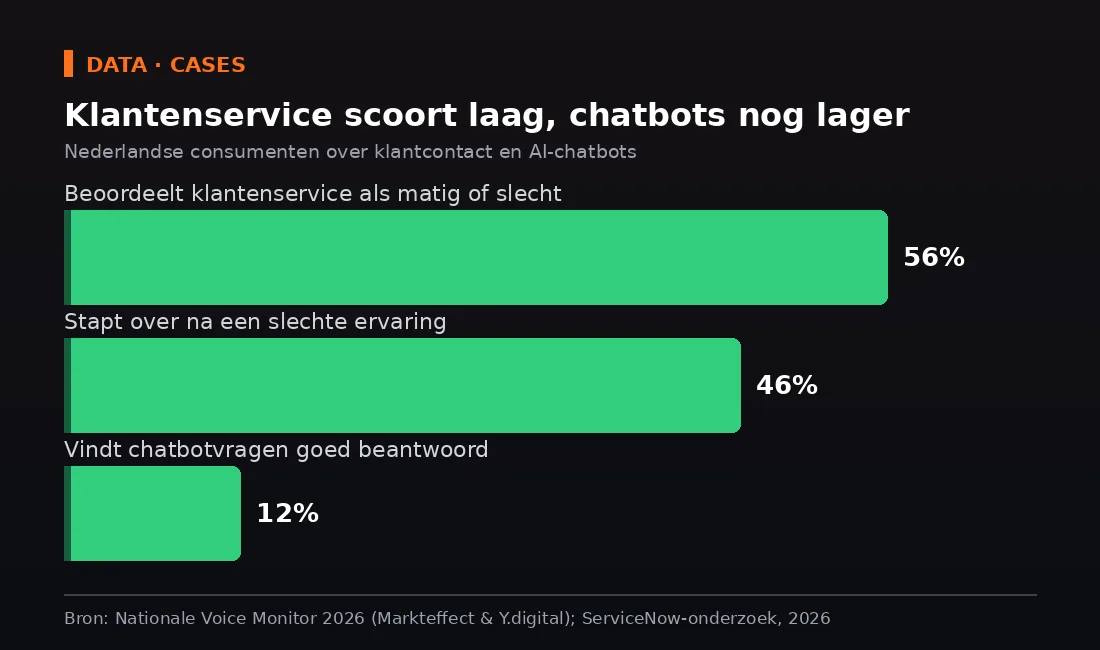
The Nationale Voice Monitor 2026, carried out by Markteffect and Y.digital, surveyed Dutch consumers about their experience with automated customer contact. The results are sobering. Only 12 percent of chatbot questions are answered satisfactorily, barely more than a year earlier. Chatbots score 0 percent as a preferred channel. Poorly functioning bots now rank second among the biggest annoyances, named by 50 percent of respondents, just behind long waiting times.
Additional research by ServiceNow, conducted among 34,000 respondents worldwide including more than a thousand Dutch consumers, shows where that lack of trust comes from. 56 percent of Dutch consumers rate customer service as average, mediocre or poor. Collectively that costs 100 million hours a year, or more than 8 hours per person. Almost half, 46 percent, switch to another supplier after a single bad experience. For a small business that is a price you cannot keep paying for long.
A company that deliberately bets on people
While many companies are automating more, the Dutch customer contact firm Stone & Bridges chose the opposite route. Founder Anouk Steenbruggen uses AI only for the simplest questions and keeps people in charge of everything that matters. The company works for brands such as Patagonia, Tony's Chocolonely, Filling Pieces, Daily Paper and Urban Arrow, and grew by 50 percent in the first quarter of 2026.
"For when you want to know how to return a parcel or pick a clothing size. But when there is urgency, emotion or repetition, an AI bot will only create more frustration."
That is how founder Anouk Steenbruggen of Stone & Bridges puts it. She draws a sharp line that most companies never draw. AI is allowed to handle the simple, factual questions. As soon as a customer is angry, has to ask something a second time, or is dealing with an emotionally charged situation, the conversation goes to a human. On paper that choice costs more staff than full automation, but it evidently produces customers who stay.
That is precisely the calculation many business owners skip. A chatbot that looks cheap because it saves hours becomes expensive the moment customers call, email or simply walk away after a failed conversation. Today's saving can end up costing next quarter's revenue.
What you can take from this
You do not need a call centre with dozens of agents to translate this approach to your own business. A few things are perfectly doable for a small team as well.
- First map out which questions are genuinely simple. Think of opening hours, shipping status, returns policy or sizing. Only those questions are suitable for automation, whichever chatbot you use.
- Build in a hard hand-over rule. As soon as a customer asks the same question a second time, expresses anger, or asks for a refund, the conversation must automatically go to an employee. Most chatbot platforms, including Dutch providers such as Trengo and Watermelon, support this kind of escalation rule as standard, as do most marketing automation tools.
- Test with real customer questions, not with made-up examples. Take the ten most common questions from your own inbox or WhatsApp over the past month and run them through the bot one by one before you go live.
- Measure satisfaction per channel separately. Compare the rating for a chatbot conversation with that for a conversation with an employee. If the gap is structural, you know immediately where to adjust.
- Set aside time for maintenance. A chatbot you configure and then leave alone ages just as quickly as a website that is never updated. Schedule a short moment every month to go through new questions and complaints.
Three assumptions that do not hold up
The first assumption is that a chatbot saves time by definition. That is only true if you filter out the simple questions properly. If the bot also answers difficult questions badly, the customer ends up with an employee anyway, only now more irritated.
The second assumption is that a more expensive or newer language model solves the problem. In earlier ServiceNow research, 61 percent of Dutch consumers already said that AI is poor at recognising emotions, regardless of how advanced the underlying model is. The problem more often lies in the set-up than in the technology.
The third assumption is that customers mainly hate a chatbot because it is stupid. The Voice Monitor shows that consumers struggle just as much when a bot forces them to simplify their question or fails to pick up any emotional tone. Smarter does not automatically make a bot more pleasant to deal with.
Want to know how to use AI in your customer service without driving customers away? Book a strategy call.
Frequently asked questions
Should a small business avoid chatbots altogether then?
No, but only use one for questions you have tested in advance and are certain it answers well. For everything else, a clear and fast hand-over to a human is often worth more than a bot that tries to invent an answer to everything.
How much time does it take to set this up properly?
For most small businesses, listing the frequently asked questions and testing them can be done in a few hours. The biggest time investment is the monthly maintenance: count on about an hour a month to process new questions.
Which signals indicate that my chatbot is actually irritating customers?
Watch for a rising number of complaints that start with a failed bot conversation, a falling rating after chat contact compared with human contact, and customers explicitly asking for an employee in the chat. If those signals occur together, adjusting is wiser than waiting.