Google Premier Partner
 Meta Business Partner

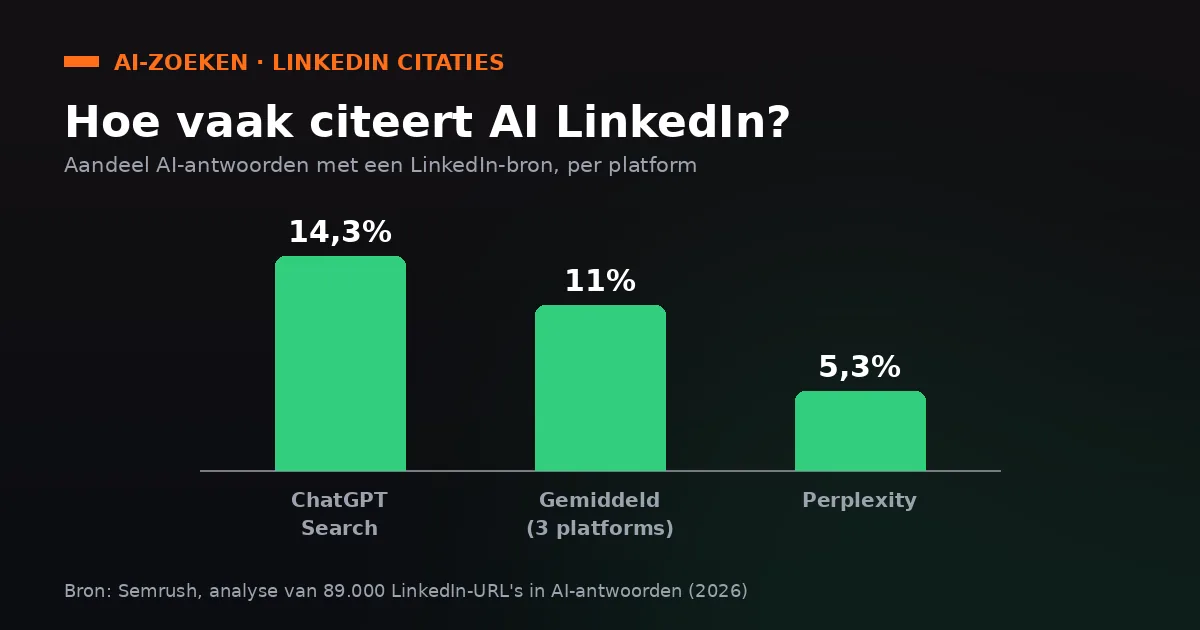
LinkedIn has stopped being just a network for job vacancies and congratulation posts. The platform has grown into one of the sources that ChatGPT, Perplexity and Google AI Mode draw on for their answers. Research firm Semrush analysed 89,000 LinkedIn URLs cited in AI answers and found that LinkedIn appears in 11 percent of those answers on average, rising to 14.3 percent for ChatGPT Search. For an SMB owner that is concrete news. What your team posts on LinkedIn can turn up in an AI answer about your industry, provided you go about it the right way. It is GEO, but for LinkedIn rather than your own website.
Why LinkedIn suddenly counts for AI search engines
AI chatbots do not answer solely from their training data. For a current or specific question they search the live web and cite sources they consider trustworthy enough. LinkedIn scores well there, probably because profiles and company pages are tied to a name and a track record. The Semrush analysis shows that the three AI systems studied treat LinkedIn differently. Perplexity cites company pages relatively often, in 59 percent of cases. ChatGPT Search and Google AI Mode do the opposite and pick content from individual authors in 59 percent of cases.
A separate study by Meltwater and LinkedIn itself, based on 9.5 million AI citations in B2B categories, confirms that picture even more strongly. There, 75 percent of citations came from personal profiles and only 25 percent from company pages. Anyone posting solely from the company account is leaving a large share of this visibility on the table.
What AI search engines cite most often
Not every post has the same chance of being cited. The Semrush data reveals a fairly precise profile. Articles, LinkedIn's long format, account for 50 to 66 percent of all citations, while ordinary feed posts stall at 15 to 28 percent. Articles of 500 to 2,000 words are cited most often, and for posts the sweet spot sits around 50 to 299 words. Strikingly, 95 percent of cited content is original material. Reshares and reposted content from others almost never make it into the citations.
What we often see among business owners is the assumption that a post with lots of likes and comments delivers the most. The research shows the opposite. The most cited posts often had just 15 to 25 reactions. Virality plays no role, relevance and recognisable expertise do. Posts that share knowledge or give practical advice outperform purely promotional content in 54 to 64 percent of cases.
Format matters more than you might think
The Meltwater study looked specifically at how frequently cited articles were built. Every top article examined used bullet points or numbered lists. 92 percent had a clear structure with subheadings, and 67 percent contained concrete figures or substantiated data. An AI system assembling an answer evidently finds it easier to pick up a piece of text that is already broken into digestible chunks, with a figure or example attached.
Virality plays no role. Relevance and recognisable expertise do.
Four steps to start on this month
You do not need to overhaul your content strategy. A few adjustments already make a difference.
- Have people with genuine expertise on your team post under their own name, alongside the company account. The figures show this significantly increases the chance of being cited.
- Write the occasional LinkedIn article of 500 to 2,000 words on a subject your company knows well, with subheadings, a list and at least one concrete figure or real-world example.
- Build a consistent posting rhythm. In the Semrush study, three quarters of the most cited authors published something new at least five times every four weeks, roughly once a week.
- Choose topics with practical value over pure promotion. A post about how to tackle something works better than a post about how good your product is.
In budget terms this costs little. The biggest investment is time, from an employee who writes one article a month and a team that shares something from their own experience every week. If that feels like a stretch, start with one expert in the business who takes the lead, and let the rest of the team join in later.
How to check whether it is working
For most companies a dashboard with these figures does not exist yet, so measuring remains manual work for now. Once a month, type a question into ChatGPT, Perplexity or Google AI Mode that fits your industry, something a customer would genuinely ask, and see whether your company or a colleague shows up in the answer or the source list. Do this a few times with different questions, because the answer varies by session and by model. If you see no change at all after a few months of posting, look at the format of your content first before abandoning the approach. The problem usually lies in missing structure or too few concrete examples, not in the subject itself.
Want to know how visible your business already is in AI answers and where the opportunities lie? Book a strategy call.
Frequently asked questions
Do I need to rewrite all my LinkedIn content now?
No. Start with new content and structure it according to the patterns that do work, with subheadings, a single list and a concrete figure or example. You do not need to adjust old posts.
Does this also work for small businesses without a content team?
Yes, especially so. The studies show that expertise and recognisability outweigh volume. One founder or specialist who occasionally shares something from their own experience can already count.
Is this the same as search engine optimisation for Google?
Not quite. The approach overlaps on points such as structure and clear language, but AI search engines select and paraphrase sources differently from the classic Google results page. LinkedIn has become a channel in its own right, separate from your own website.