SEO & GEO Sander·Team Lead SEO, GEO & Website
How to get AI search engines to cite your LinkedIn content
Sander·Team Lead SEO, GEO & Website Google Premier Partner
 Meta Business Partner
A top Google ranking does not guarantee an AI citation. Learn what query fan-out is and how you can start improving your AI visibility today.
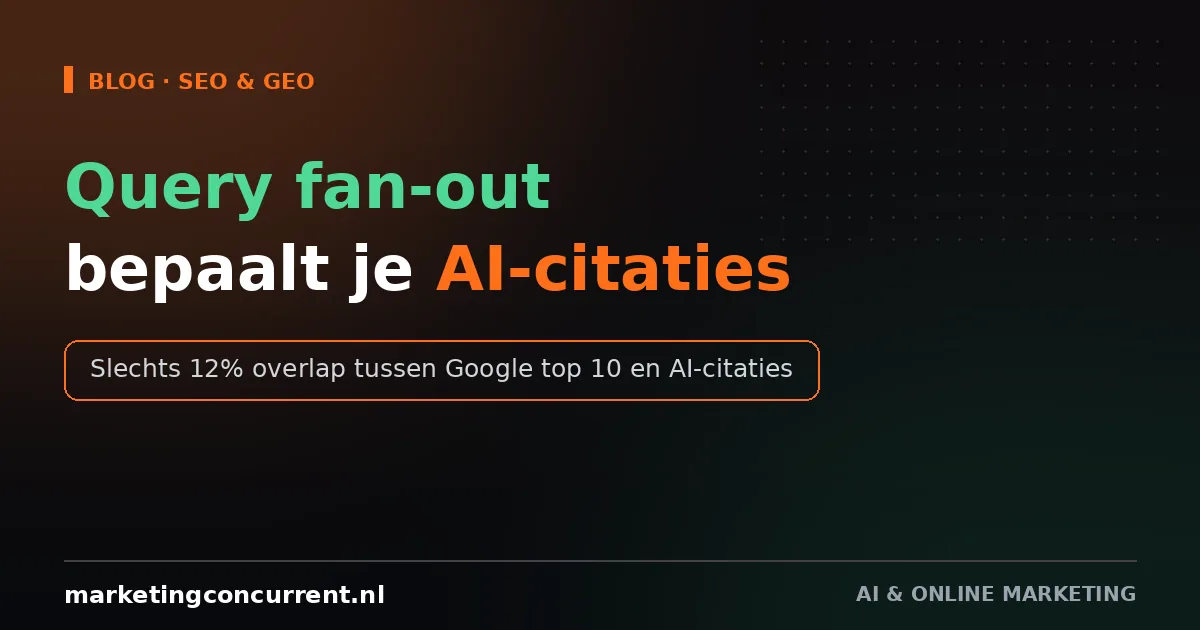
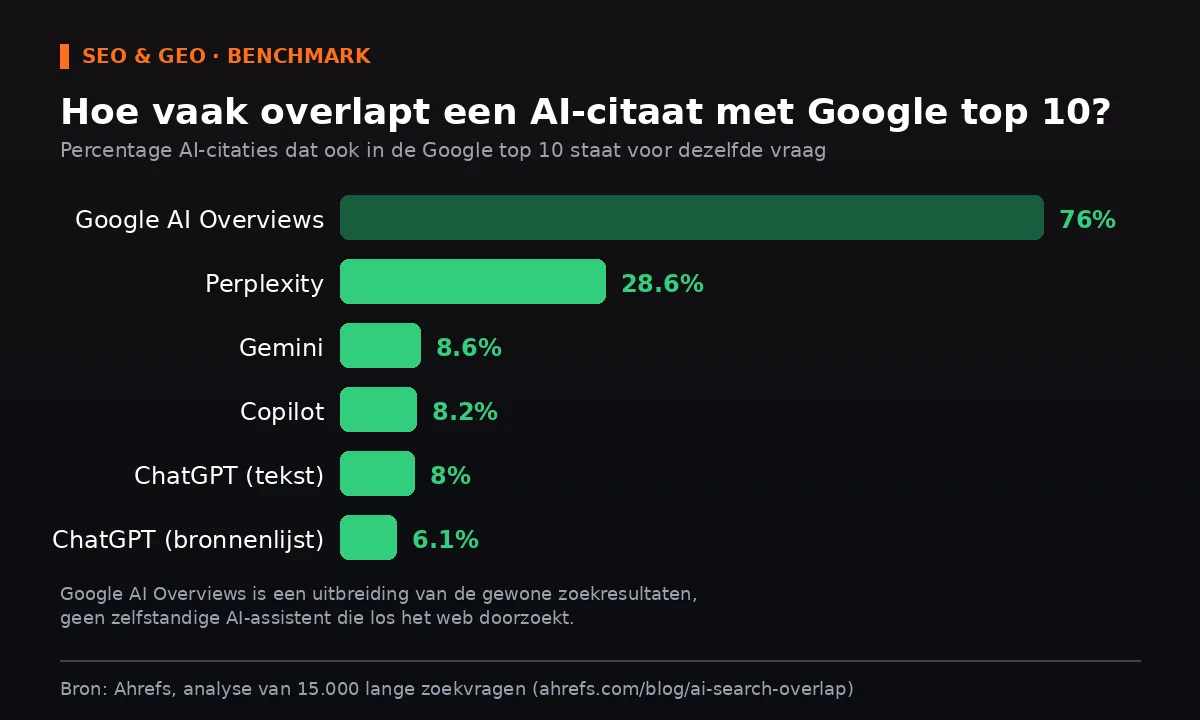
Is your website ranking first or second in Google for an important search term? Good work, but it says less and less about whether ChatGPT, Gemini or Copilot will mention you when someone asks the same question there. Research by Ahrefs into 15,000 long search queries showed that on average only 12 percent of the sources cited by ChatGPT, Gemini and Copilot also appear in Google's top ten for that same query. For Perplexity the figure is slightly higher at 28.6 percent, but even that is a fraction of what you would expect if AI answers simply copied Google results. The reason is called query fan-out. Behind the scenes, AI assistants ask a whole series of variations of your question and merge the results into a single answer. What this means for your findability and where GEO still gives you real influence, you can read below.
An AI chatbot works differently from the Google search bar. Type a question into ChatGPT or Perplexity and the system often splits it into several sub-questions, searches for each variation separately, and then merges the sources it finds into a flowing answer. Ask for the best accounting software for freelancers, for example, and the assistant may turn that into separate sub-searches for pricing, reviews, integrations and comparisons, citing different sources for each of those pieces.
The result is an answer built from fragments of dozens of pages. A sizeable share of those would never appear in Google's top ten for your original search term. Ahrefs calculated that around 80 percent of the sources cited by AI assistants cannot even be found anywhere in the first hundred Google results for that original query.
Not every AI feature works the same way. Google's own AI Overviews, the summaries that sometimes appear above the regular search results, do draw 76 percent of their sources from the top ten of that same search engine. That makes sense, because AI Overviews are essentially an extension of the existing search results rather than a standalone system that searches the whole web afresh. ChatGPT, Gemini and Copilot do exactly that, and there the overlap drops to around 8 percent. Perplexity sits in between at almost 29 percent.
For a small or medium-sized business website this means a strong position in the organic search results is no longer a guarantee of visibility in a chat conversation, especially not with the standalone AI assistants that go and do their own research.
A good position in Google is not a visa for a chat conversation. AI assistants ask the questions you never typed.
Research firm Omniscient Digital dissected more than 23,000 AI citations from ChatGPT, Perplexity and Gemini, spread across four sectors and six types of search intent. The outcome is worth knowing before you keep looking only at your own site. Almost half of the cited sources, 48 percent, are independent media such as editorial articles, review sites, forums and industry directories. Another 30 percent comes from commercial content that is not your own, think of competitors' comparison pages or affiliate sites. Only 23 percent of citations come from the website of the brand the question is about.
That percentage varies strongly by type of question. For queries that resembled a request for customer reviews, 82 percent of citations came from independent media. When the question was about how a product works, the share of own content rose to 50 percent. So for a question like "does this product do what it promises" an AI system is quicker to trust what the manufacturer itself says, while for a question like "is this reliable" it prefers to look for an independent voice.
After numbers like these, the temptation is to keep optimising mainly your own website. That remains worthwhile, certainly for questions about the functionality and workings of your product or service. It is just no longer the whole story. What we often see with websites is that nobody ever deliberately works on mentions outside the site itself. No active approach to reviews on Trustpilot or Google, no contact with trade media, no presence in comparison articles on industry sites. Yet according to the research, exactly those places fill almost half of what an AI system cites.
On top of that comes the spread across separate sub-questions. Because an AI assistant chops your main question into smaller pieces, a single strong landing page gets you less than it used to. It works better to write standalone, self-explanatory blocks of text per sub-question, for example one for pricing, one for integrations and one for a comparison with alternatives. Each block must be readable without needing the rest of the page, because that is exactly how a language model cuts it out.
Want to know where your brand stands today in the answers of ChatGPT, Perplexity and Gemini? Book a strategy call.
No. Links still help crawlers find your content and contribute to the authority of your domain. What the studies show is that unlinked mentions on independent platforms count at least as heavily towards what an AI system cites. So the focus shifts from link building alone to a broader presence in the places that matter in your sector.
Manually typing your most important questions into ChatGPT, Perplexity and Gemini is a fine starting point and costs nothing. If you want to track this structurally, there are now specialised tools such as Peec AI that monitor citations across several AI platforms at once. For most small business sites, periodic manual testing is enough for now.
Yes. The Ahrefs research showed that Perplexity had the highest overlap with Google results, while ChatGPT and Gemini showed the lowest. Each platform retrieves its sources in its own way. Reason enough to test each platform separately instead of relying on a single AI visibility check.
Leads the SEO, GEO and web team and works on visibility in Google and in AI answers, from technical foundations to content. Questions about this article? Book a strategy call or meet the whole team.
Sander·Team Lead SEO, GEO & Website Sander·Team Lead SEO, GEO & Website