ChatGPT Ads Damien·Team Lead SEA
Instant checkout in ChatGPT converts 3x worse than your own site, and this is where the real opportunity lies
Damien·Team Lead SEA Google Premier Partner
 Meta Business Partner
ChatGPT has shown ads in 31 European countries since 24 August. What does a click cost, who sees the ads and what can a small business do right now?
Since Monday 24 August there have been ads in ChatGPT, in the Netherlands and across Europe. OpenAI switched them on in 31 European countries in one go. Only people using the free version or the low-cost Go subscription see them, recognisable by the label "sponsored" below the answer. Should you, as a business owner, act on this straight away? For most small and medium-sized businesses the answer is no for now, at least not with budget. In Europe, advertising is currently only possible through OpenAI's advertising team or through large media agencies. What you can do is watch closely and prepare, so you are ready the moment the self-service platform opens. In this article you will read how the ads work, roughly what a click costs, and which steps are already worth taking this week, whether your business is based in the Netherlands or elsewhere in Europe.
ChatGPT has become a daily habit for many people in the Netherlands. According to Emerce, around 4.8 million Dutch people use the chatbot every month, roughly a quarter of the population. Until last week that was an ad-free environment. That is over. OpenAI now shows ads in the 27 EU countries plus Iceland, Liechtenstein, Norway and Switzerland.
Not everyone sees them. Paying users of Plus, Pro and the business subscriptions are left out, as are accounts of users under 18. So the ads appear for the broad audience that uses ChatGPT for free. US figures cited by Emerce show that ChatGPT there shows an ad on roughly a quarter of commercial queries. Think of questions like "which campervan suits a family with three children" or "find an accountant for my online store". Exactly the kind of orientation questions your business wants to be the answer to.
Frankwatching describes two formats you will encounter now. Product ads with an image, title and price, comparable to Google Shopping. And ads for services and accommodation, which appear in a carousel alongside several providers.
The targeting differs from what you know from Google Ads. There are no keywords. The system looks at the content of the current conversation, the language and the user's approximate location. In Europe, personalisation is deliberately switched off at launch: OpenAI uses no chat history and no saved preferences to select ads, precisely in order to stay within European privacy rules. Advertisers only see aggregated figures, such as impressions and clicks, and therefore no conversations or personal data.
OpenAI further states that ads do not influence the answer itself and stay away from sensitive topics such as health and politics. That separation between answer and ad matters for users' trust, and therefore for you as an advertiser too.
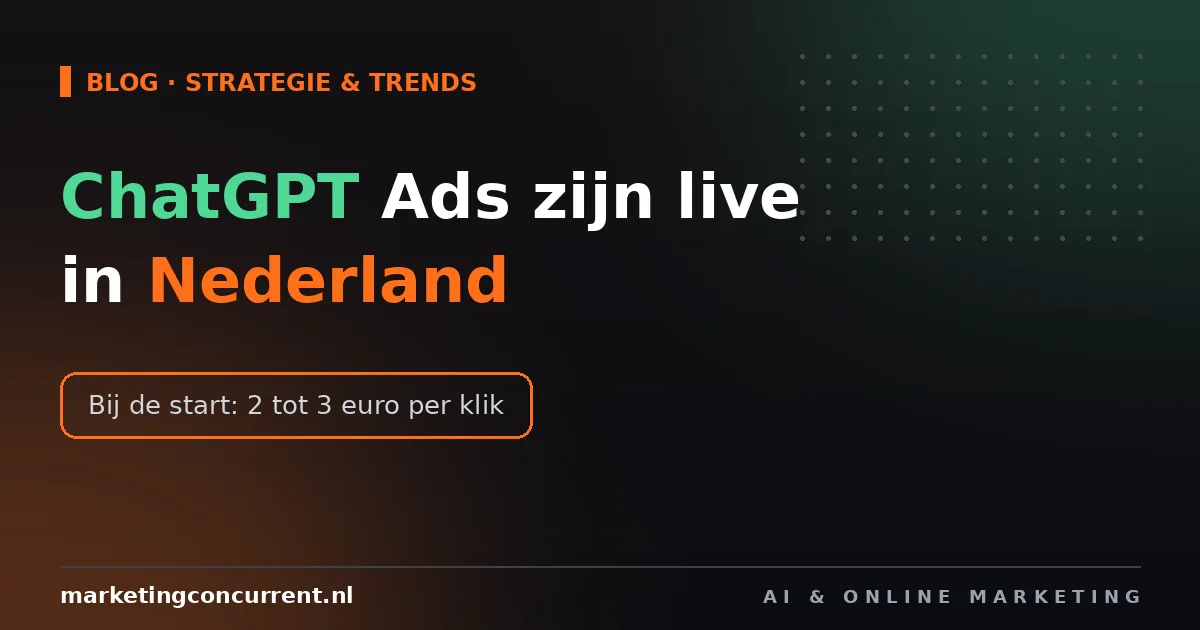
For the Netherlands, Frankwatching expects a click price of 2 to 3 euros. OpenAI itself works internationally with 3 to 5 dollars per click. You can buy on a per-click or per-impression basis, and Emerce quotes media agency Omnicom on the option of optimising for conversions while paying per click.
For comparison: that price level is close to what many small businesses currently pay for a non-brand click in Google Ads. So do the maths before you get excited. Suppose a click costs 2.50 euros and 2 percent of visitors become customers, then you pay 125 euros in media costs per new customer. For an online store with a margin of 30 euros per order that is too expensive; for an accountant whose clients stay for years it can work out fine.
For now, entry runs through OpenAI's Ads Solutions team, through media agencies or through technology partners. You can register at ads.openai.com, although access is not guaranteed. The self-service Ads Manager, which lets you set up campaigns yourself just as you do with Google and Meta, is not yet live in Europe. Emerce expects it later this quarter.
How busy is it, really? On 19 August the Amsterdam agency PromptMarketing launched a public ChatGPT Ad Library, a register of ads that users share via a browser extension. In a single US category for B2B software they counted 165 different advertisers with more than 800 sponsored placements in 90 days. On Dutch consumer queries they saw not a single ad at launch.
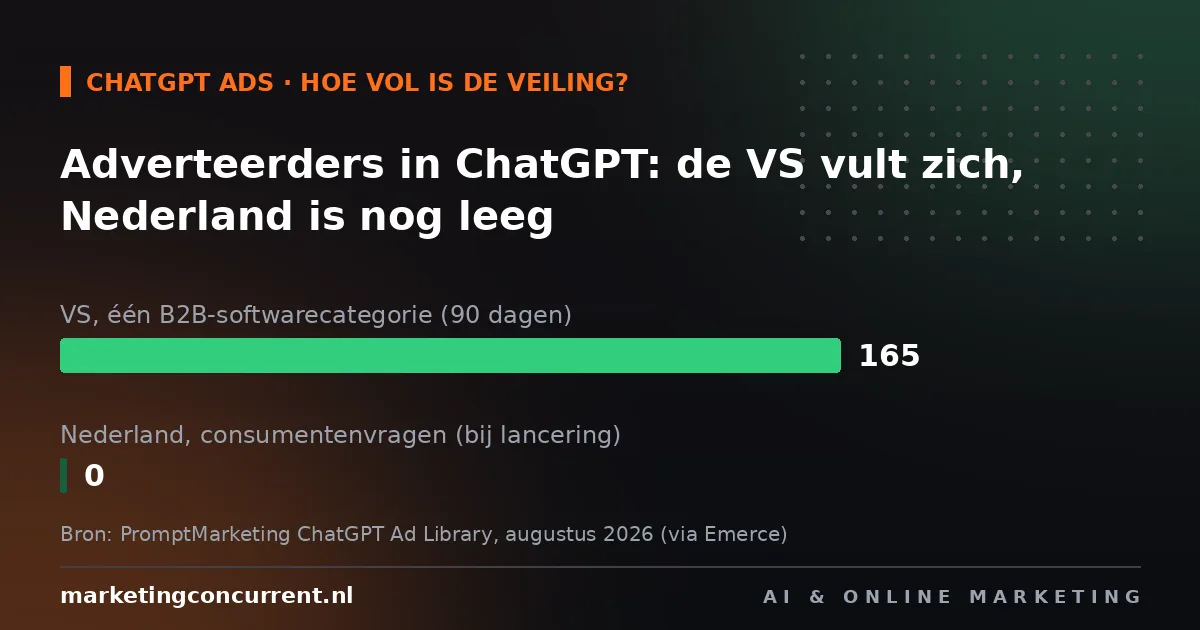
A click in ChatGPT costs 2 to 3 euros, and at launch not a single advertiser was visible on Dutch consumer queries. It will not stay that empty for long.
What we often see at companies is that they only look at a new channel once a competitor is already visible there. With ChatGPT Ads the order is more favourable. You can calmly watch how the US market fills up while the Dutch auction is still empty, and other European markets that went live on the same day are unlikely to look much busier yet. Omnicom, one of the first agencies active on the channel in the Netherlands, has already run around 70 test campaigns internationally. So the first serious advertisers are raring to go.
You do not need to spend money yet. These five things take an afternoon in total and make sure you are not at the back of the queue once the channel really opens.
One sober footnote. Ads in a chatbot touch on trust, and users are sensitive to that. So test small when the time comes, look critically at the quality of the traffic and compare the cost per customer with your existing channels before you shift budget.
Read also: Instant checkout in ChatGPT converts 3x worse than your own site, on where the real opportunity in ChatGPT commerce lies.
Not independently yet. The self-service Ads Manager is not available in Europe, so access runs through OpenAI's Ads Solutions team, media agencies or technology partners. You can already register at ads.openai.com, and Emerce expects the self-service version later this quarter.
Only users of the free version and the Go subscription see ads. Paying users and people under 18 do not. Since, according to Emerce, around 4.8 million Dutch people use ChatGPT every month and by far most of them use the free version, the reach is still considerable, and the same logic applies in every other European market where the ads went live.
The organic side does not change. Ads sit below the answer and, according to OpenAI, do not influence its content. Working on your visibility in AI answers, for instance with clear product information and good source references on your site, therefore remains just as valuable as it was before the ads arrived.
Leads the SEA team and manages Google Ads accounts for online stores and dropshippers every day, from Shopping structure to bidding on margin. Questions about this article? Book a strategy call or meet the whole team.
Damien·Team Lead SEA
 Sander·Team Lead SEO, GEO & Website
 Ruben