Google Premier Partner
 Meta Business Partner
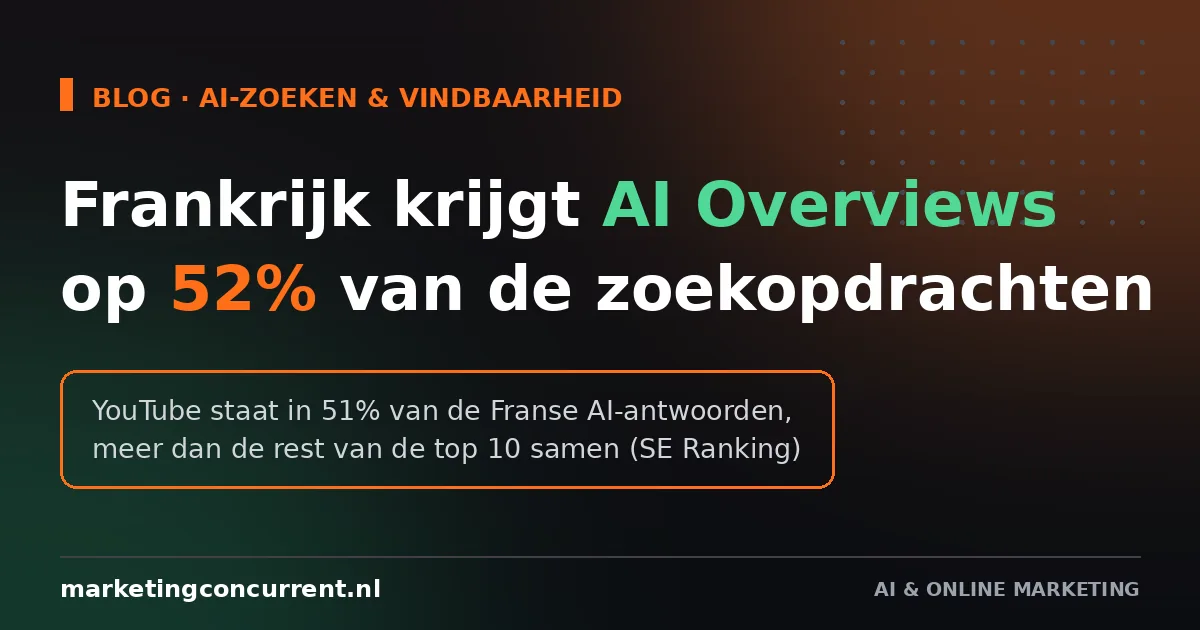
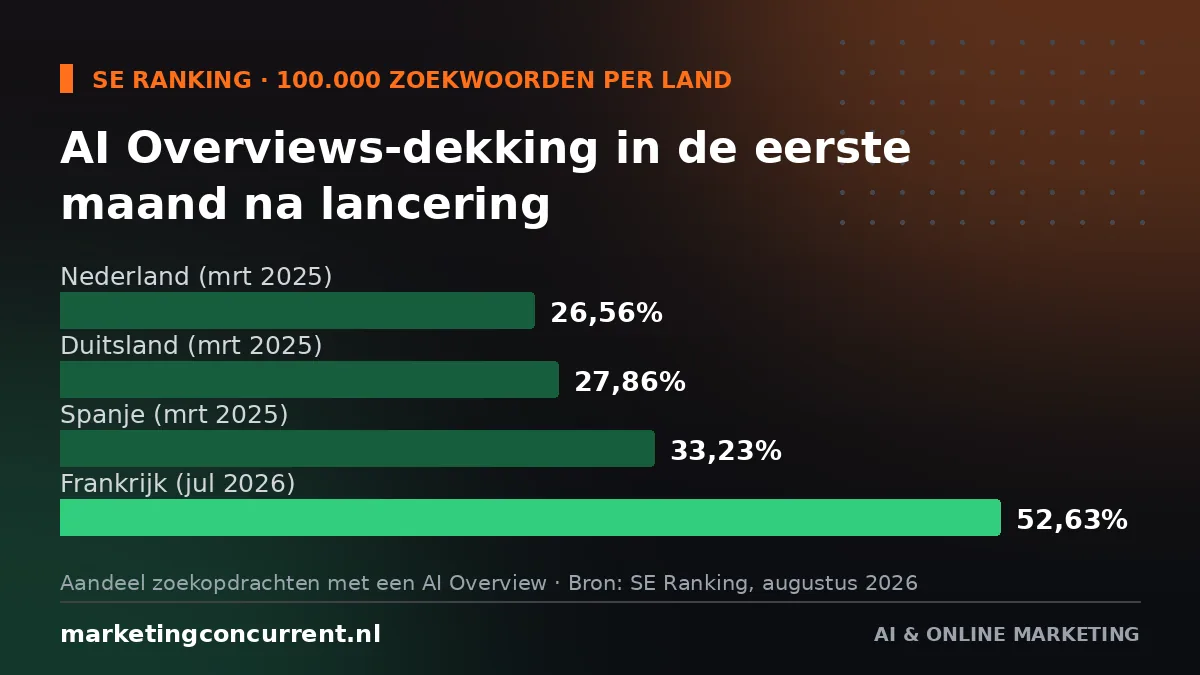
Google switched on AI Overviews in France on 22 July, as one of the last major European markets. Three weeks later the AI summaries were already appearing on more than half of all searches. What does that tell marketers elsewhere in Europe? The figure is 52.63 percent of searches, according to a study by SE Ranking of 100,000 French keywords. By comparison, the Netherlands started at 26.56 percent in March 2025.
Why would a marketer in Germany, the UK or the Netherlands look at French figures? Because the French launch shows how Google now positions this feature as the mature product, with no cautious ramp-up phase. The coverage that earlier European markets took more than a year to grow into is there in France from day one. The same dataset also reveals which sources Google favours in AI answers, and that is where the real news lies. YouTube appears in well over half of all French AI Overviews. Anyone still aiming their findability strategy entirely at their own website is optimising for an ever smaller share of the answer.
What SE Ranking actually measured
The basics first. On 7 and 8 August, SE Ranking analysed 100,000 French keywords spread across twenty industries with 5,000 keywords each. That produced more than 52,000 AI Overviews with a total of 363,330 source citations from more than 30,000 unique domains. Not a small sample, then, but one of the largest measurements since the European rollout began.
The comparison with earlier launches is striking. Germany sat at 27.86 percent coverage in its first month, Spain at 33.23 percent and the Netherlands at 26.56 percent. France starts at 52.63 percent, almost double. Over the past eighteen months Google has not only added markets but also lowered the threshold at which a search receives an AI answer. There is little reason to assume that coverage in those earlier markets is still at the level of their launch months. Anyone basing their picture of AI Overviews on last year's first measurements is looking at an outdated photograph.
YouTube is the real news
The source list is the discovery of this study. YouTube appears in 51.31 percent of all French AI Overviews and accounts for 14.33 percent of all source citations. That is more than the other nine domains in the top ten combined. It is followed by Facebook (3.51 percent), the French government site service-public.gouv.fr, Wikipedia, Instagram and TikTok.
YouTube features in 51 percent of French AI Overviews. Anyone still treating video purely as a branding channel will soon be missing from half of the AI answers.
For marketers across Europe this is the most concrete lesson in the entire dataset. An explainer video on your subject now stands a chance of a place in the AI answer itself, while your blog article on the same subject has to compete with tens of thousands of other pages. What we often see at companies is that video lives outside the SEO team, with brand or social. With these figures in hand, that separation is worth challenging. Transcripts, chapter markers and a title that literally answers the search query make a video findable for Google's AI, and that work costs a fraction of a link building campaign.
Classic rankings remain the foundation, with a major caveat
Good news for anyone who has invested in SEO for years. Of the cited URLs, 60.46 percent ranked in the organic top ten and 76.33 percent in the top fifty. More than a quarter even came from the top three. Strong organic positions therefore remain the most likely route to a source citation.
The caveat lies in the rest. Almost a quarter of cited sources ranked outside the top fifty. Google's AI digs deeper than the classic first page and rewards pages that answer a sub-question sharply, even if the domain never reached a top position. An average AI answer cites 6.91 sources from an average of 5.6 different domains. So there are several spots to win per answer, and they do not all go to the familiar names. The concentration at the top is firm, though: nine domains together take a quarter of all citations.
Not every industry feels the same effect
The differences per sector are large. Business searches received an AI Overview in 87.1 percent of cases, insurance sat at 73.62 percent and health at 71.02 percent. At the bottom dangle fashion and beauty at 20.28 percent, food at 20 percent and e-commerce at 33.58 percent. Long, specific questions weigh heavily. Nine-word searches received an AI answer in 71.32 percent of cases, compared with 49.48 percent for a single word.
One more detail that often gets lost in the debate. Of the classified sources, 89.34 percent were in French, and in sectors such as finance, legal and insurance that rose to around 97 percent. Google builds AI answers almost entirely on local content in the local language. The idea that an English-language content hub will also cover your AI visibility in the German, Dutch or French market does not hold up against this data.
What this means for your approach in the rest of Europe
Our position after these figures. Stop treating AI Overviews as an experiment you monitor and make them a fixed part of your findability work, with its own emphasis alongside your classic SEO.
- First measure how often your most important keywords in your own market already show an AI Overview, per funnel stage. If you are in B2B, insurance or health, this hits your visibility harder than average.
- Give video a place in your SEO roadmap. Start with the ten questions you already rank for organically and turn them into short videos that answer them literally, with a transcript and chapters.
- Keep pushing for top positions for your core pages; that remains the main route to citations. Alongside that, build pages that answer one sub-question completely, because that is where the citations for domains outside the top lie.
- Write for each market in its own language. Local language and local sources dominate the answers, especially in legal and financial sectors.
The French launch is a mirror that hangs a little further ahead in time. What is there on day one is the standard the results pages in the rest of Europe are moving towards. There is no need to panic, but the window in which you can calmly practise with video and AI-oriented content is shrinking every quarter.
Frequently asked questions
Do these French figures also apply to other European markets?
Not one to one. The study measures the French market at a single moment. The pattern is transferable, though, because Google rolls out AI Overviews everywhere through the same system, and the French starting coverage shows how far that system has come. So measure your own keyword set in your own market before shifting budgets.
Does YouTube's dominance mean text content is worth less?
No. Six of the average seven source citations per answer point to sources other than YouTube, and 60 percent of citations come from the organic top ten. Text remains the backbone. Video has been added as an answer format and therefore belongs alongside your existing content, as a complement, not a replacement.
How do I check whether my brand appears in AI Overviews?
Virtually all major SEO suites, including SE Ranking, Semrush and Ahrefs, now show per keyword whether an AI Overview appears and which sources it contains. Start with your top fifty keywords and record which competitors or platforms are currently cited, giving you a baseline to measure progress against.